



Why Cloud cost management requires an integrated FinOps approach
Cloud enables speed, scale, and innovation. Turning cloud spend into measurable business value requires governance and ownership that match its dynamic, consumption-based nature. Many organizations start with cloud cost management: budgeting, forecasting, reporting, and explaining spend after the fact. These capabilities improve transparency, but on their own they do not enable sustained optimization or better decisions.
FinOps goes further.
FinOps is the discipline that enables organizations to optimize cloud spend through informed trade-offs, embedding cost, performance, and risk considerations into technical and business decisions, early and continuously. Across organizations, the same challenges tend to surface.
Cloud cost data is available, but accountability cannot be established due to a lack of data or insight. Costs are discussed, but end-to-end responsibility for acting on them is unclear. Budgets explain what happened but provide limited guidance on how to steer forward.
“Application teams control the spend, but IT gets blamed for the bill.”
“I can’t hold teams accountable because costs aren’t mapped to owners.”
Tooling and reporting increase visibility, but do not establish a recurring decision rhythm or clear prioritization of trade-offs. Optimization remains ad-hoc and difficult to sustain.
“We can see the numbers, but they don’t tell us what to do”
“I lack an integrated view of spend my and optimization potential”
Each function optimizes from its own perspective, leading to friction, escalation, and suboptimal trade-offs. Optimization discussion exists but occur late in the life cycle, after workloads are built and deployed.
“Finance, IT and engineering all look at cloud costs differently.”
“If cloud is pay as you go, why do our costs only go up?”
Rightsizing, commitment decisions, and allocation rely heavily on manual intervention. As cloud environments grow in complexity, consistency decreases and opportunities are lost.
“I know we’re wasting money in the cloud; I just don’t know where.”
“We have tooling in place but executing optimization is just too cumbersome”
Unlock the Hidden Drivers of Your Cloud Spend
We need better control over our cloud spend
Cloud costs grow continuously and variably, making it hard for finance and IT leadership to predict, explain and control spend.
Organizations struggle to balance engineering flexibility with financial control, leading to budget overruns, volatility and reactive optimization.
We lack visibility into what drives our costs
Organizations can see cloud spend but lack insight into what drives it and how architectural or usage choices affect cost.
Without insight into how usage, architecture and service choices influence cost, leadership lacks the information needed to make deliberate performance–risk–cost trade-offs.
We have limited leverage in cloud vendor discussions
Vendor negotiations are often conducted without a clear, independent understanding of usage, pricing mechanics and the most impactful commercial levers.
As a result, discussions focus on headline discounts rather than long-term cost, flexibility and risk.
We struggle to allocate cloud costs reliably
Vendor negotiations are often conducted without a clear, independent understanding of usage, pricing mechanics and the most impactful commercial levers.
As a result, discussions focus on headline discounts rather than long-term cost, flexibility and risk.
Stakeholders want clearer insight and accountability
Cost reports exist, but they do not lead to clear decisions, ownership or follow-through.
Insight is available but not embedded into how cloud decisions are made across finance, IT and the business.
Our cloud cost management processes are too manual
Manual effort dominates cloud cost management and does not scale with growing complexity.
Without policies, automation and the right tooling, insight arrives too late and opportunities for proactive steering are missed.

The common challenge is not cloud technology itself
Cloud costs become visible, but they are not actively governed or used to maximize business value though cost performance and risk trade off decisions.
That is why effective FinOps is not about better reports or isolated optimizations, but about creating an operating model that connects accountability, insight and execution.
We support organizations in evolving from cloud cost management toward integrated FinOps: a management capability that aligns people, processes, governance, and tooling, and positions cloud costs within the broader context of IT cost management and business value.
How we help organization regain control with integrated FinOps
Maximizing business value with FinOps requires more than cost transparency or tooling. It requires a coherent operating model that aligns people, processes, governance and tooling around shared objectives and decision-making.
We help organizations operationalize FinOps
- Not as a tool
- Not as a report
- Not as a policy
But as a working management capability embedded in your organization.
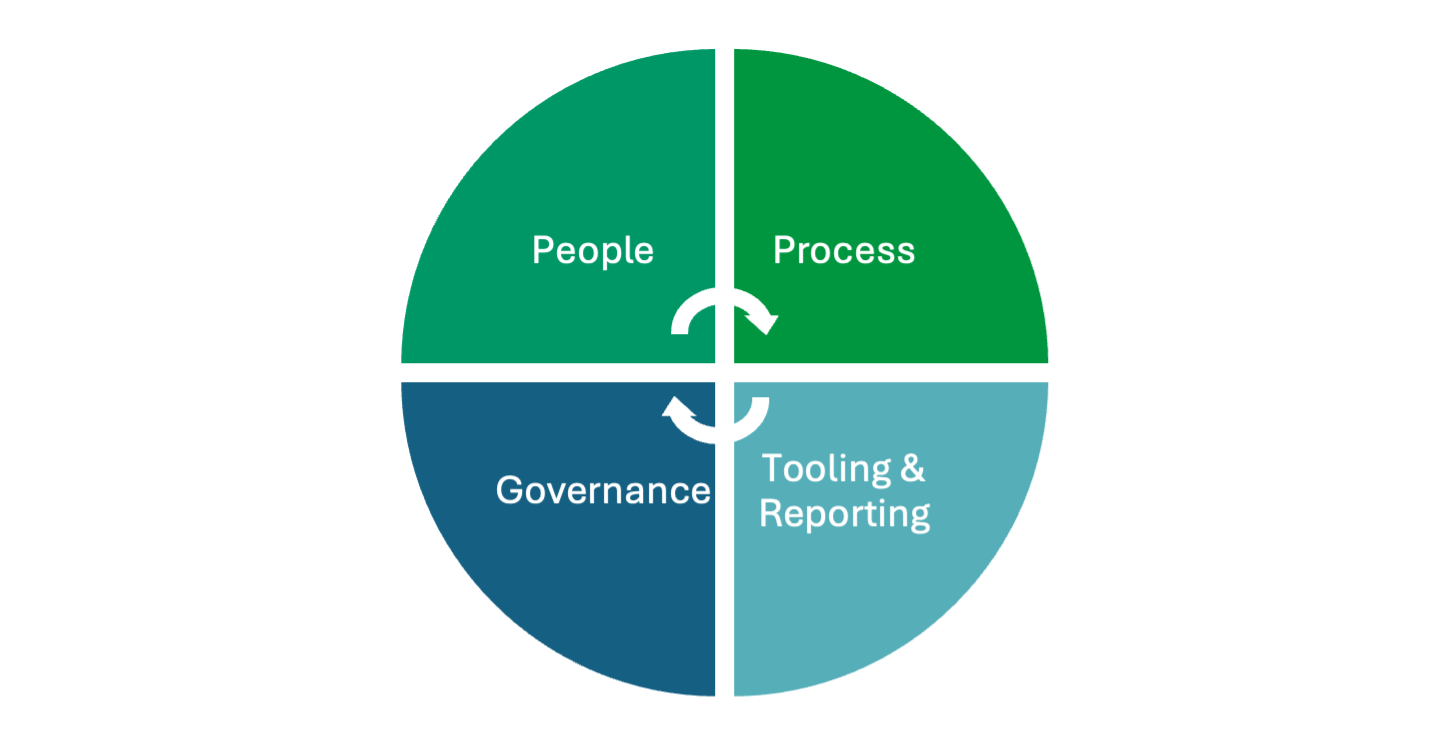
We design, implement operating models as well as deliver technical solutions with the ability to connect to senior management and bridge the gaps between finance, IT, procurement and business. This enables:
Trusted financial transparency for leadership
A single, consistent view of cloud costs aligned with budgets, forecasts and accountability structures.
Decision-ready insight, not just visibility
Application teams and leadership can assess cost, performance and risk jointly to enable value-based decisions.
Governance that enables value creation
Clear guardrails and escalation paths that support autonomy while safeguarding enterprise objectives and maintain control.
Cross-functional collaboration
Finance, IT, procurement and business operate from shared definitions, metrics and priorities.
Alignment between cloud spend and business value
Through integration with Technology Business Management (TBM), cloud costs are connected to services, products, and strategic priorities.
Wir erbringen Dienstleistungen für